

A wrongful death settlement in Nevada can vary widely depending on the circumstances of the death, the losses suffered by the family, the evidence of fault, and the insurance coverage available. There is no single amount that applies to every wrongful death case.
The value of a wrongful death claim does not come from simply multiplying the deceased person’s income by a certain number. Nevada law allows different types of damages, and the claims of the statutory heirs are separate from certain claims brought by the personal representative of the estate. Nevada Revised Statutes Chapter 41 explains the damages that may be available.
How Much Is a Wrongful Death Settlement Worth in Nevada?
There is no standard wrongful death settlement amount in Nevada. Two families can lose a loved one in similar accidents and still have very different claims.
The amount may depend on the deceased person’s age, income, expected future earnings, role in the household, relationship with surviving family members, medical and funeral expenses, and the circumstances that caused the death. The strength of the liability evidence and the amount of available insurance can also make a significant difference.
In other words, an online settlement calculator or an advertised “average” does not tell you what your case is worth.
What Damages Can Be Included in a Nevada Wrongful Death Claim?
Nevada law allows qualifying heirs to seek certain damages resulting from the death. The personal representative of the estate can also pursue certain damages belonging to the estate.
Depending on the facts of the case, damages can include:
- Loss of probable financial support
- Loss of companionship, society, comfort, or consortium
- Grief or sorrow suffered by qualifying heirs
- Medical expenses incurred before death
- Funeral expenses
- Certain damages the decedent could have recovered had the decedent survived
The exact damages available depend on the claim, the parties involved, and the facts of the case.
How Is Lost Financial Support Calculated?
One of the most important parts of some wrongful death claims is the financial support the deceased person would probably have provided to the family.
This is not necessarily the same as the person’s annual salary. An evaluation can consider income history, expected future earnings, benefits, career progression, work-life expectancy, taxes, personal consumption, and the portion of the person’s resources that would likely have supported the household.
For a younger person with a long expected working life, the future-income analysis can be substantial. For a retired person, the calculation may look very different.
An academic study on calculating compensation in wrongful death cases discusses why economists look at more than a person’s current salary when evaluating future losses.
Can a Family Recover the Value of Household Services?
Yes, the economic value of household services can be relevant to a wrongful death claim.
A parent or spouse may provide childcare, transportation, cooking, cleaning, home maintenance, and other services without being paid for them. When that person dies, the family may lose services that would otherwise have had to be provided by another family member or purchased from someone else.
The evidence may include information about the person’s responsibilities in the household, the needs of the children, and the cost of replacing certain services.
What About Loss of Companionship and Grief?
A wrongful death claim is not limited to lost income.
Nevada law allows qualifying heirs to seek damages for losses such as grief or sorrow, companionship, society, comfort, and consortium. These damages recognize the personal impact that the death can have on a spouse, child, parent, or other qualifying heir.
The relationship between the deceased person and the surviving family members can be important. Evidence may include the person’s role in the family, shared activities, daily routines, and the ways the death changed the family’s life.
Do Medical and Funeral Expenses Count?
Why Does Insurance Coverage Matter?
The amount of available insurance can affect the practical value of a wrongful death claim.
Depending on how the death occurred, there may be automobile insurance, commercial liability coverage, premises liability insurance, professional liability coverage, or other applicable policies.
A claim can involve significant damages and still face a practical limit if the available insurance coverage is limited and the responsible party has few collectible assets. That is why an insurance investigation can be an important part of evaluating a wrongful death case.
Can Comparative Negligence Reduce a Wrongful Death Recovery?
It can, depending on the facts and the applicable Nevada rules.
If the evidence suggests that the deceased person contributed to the accident, the parties may dispute how much responsibility should be assigned to the decedent. That allocation can affect the amount ultimately recovered.
For that reason, a wrongful death investigation should examine not only what the other party did, but also the evidence surrounding the decedent’s actions.
Does the Age of the Deceased Person Affect Settlement Value?
It can, particularly when the claim includes lost financial support.
A younger person may have had many years of expected earnings and household contributions remaining. A retired person’s economic-loss calculation may be different. Age can also be relevant to life expectancy and the expected duration of certain family relationships and contributions.
Age is only one factor, however. It should not be used by itself to predict the value of a wrongful death case.
Why Is There No Average Wrongful Death Settlement in Nevada?
Settlement amounts from other cases can be useful for context, but they are not a formula.
Cases involve different defendants, insurance policies, evidence, family relationships, incomes, ages, injuries before death, and liability disputes. A settlement from one case may therefore have little connection to the value of another case.
For example, a May 2026 Las Vegas Review-Journal report described a $275,000 settlement approved by Henderson involving the family of a 12-year-old boy killed during a 2020 standoff. That figure should not be treated as an average or a prediction for another case.
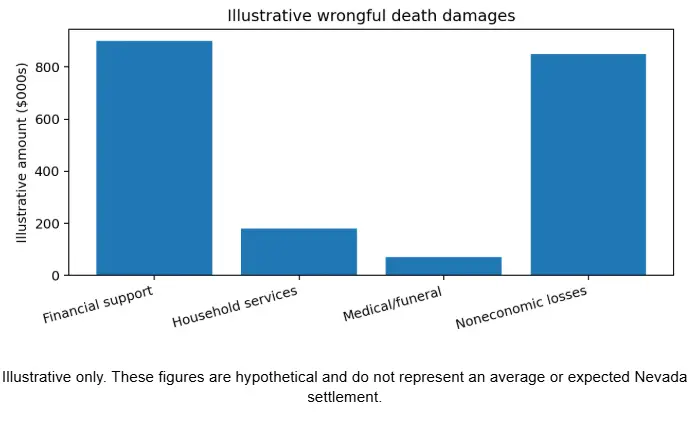
What Does a Wrongful Death Settlement Calculation Look Like?
| Category | Illustrative amount |
|---|---|
| Lost financial support | $900,000 |
| Household services | $180,000 |
| Medical and funeral expenses | $70,000 |
| Noneconomic losses | $850,000 |
What Evidence Is Used to Calculate a Wrongful Death Claim?
The evidence depends on how the death occurred and what damages are being claimed.
- Police or incident reports
- Medical records and bills
- Employment and income records
- Tax returns and benefit information
- Insurance policies
- Photographs and video
- Witness statements
- Accident reconstruction or other expert opinions
- Evidence of the deceased person’s role in the family
- Funeral and burial expenses
Preserving evidence early can be important, especially when the case involves a vehicle collision, commercial vehicle, unsafe property, defective equipment, or electronic evidence that may not be available later.
Does a Wrongful Death Claim Belong to the Family or the Estate?
Both can be involved, but the claims are not necessarily the same.
Under NRS 41.085, qualifying heirs and the personal representative can maintain claims, with different categories of damages available under Nevada law.
That distinction matters when evaluating a settlement because the value of the heirs’ claims and the estate’s claims may need to be considered separately.
How Long Does a Wrongful Death Settlement Take?
There is no standard timeline.
A case may move more quickly when liability and insurance coverage are clear. It can take longer when there are multiple defendants, disputed fault, complicated financial losses, or significant disagreement about the value of noneconomic damages.
Families should be careful about accepting an early settlement before they understand the full scope of the claim.
Frequently Asked Questions About Wrongful Death Settlements in Nevada
Is there a minimum wrongful death settlement in Nevada?
Is there a maximum wrongful death settlement in Nevada?
How much is a wrongful death case worth if the person was the family's main income earner?
Can children receive compensation after a parent's wrongful death?
Can a spouse receive compensation for loss of companionship?
Does a wrongful death settlement include funeral costs?
Can medical bills from before death be included?
Does insurance pay the entire wrongful death settlement?
Can the other side argue that the deceased person was partly at fault?
Should I accept the insurance company's first wrongful death settlement offer?
How long do I have to file a wrongful death claim in Nevada?
Can a wrongful death case go to trial?
Talk to a Nevada Wrongful Death Lawyer
A wrongful death claim involves more than putting a dollar figure on the loss. The cause of the death, evidence of fault, available insurance, the deceased person’s financial contributions, and the losses suffered by surviving family members can all affect the outcome.
Ralph A. Schwartz, PC represents clients in personal injury and wrongful death matters in Las Vegas and throughout Nevada. Learn more about wrongful death and personal injury representation or contact Ralph A. Schwartz, PC to discuss your situation.
Call (702) 888-5291 or schedule a free consultation to discuss your case.
This article is general information about Nevada law, not legal advice for your specific situation.