Many people assume that carrying a handgun in Nevada is simple. In practice, the state has specific rules about who can carry a concealed firearm, where they can bring it, and what paperwork they need to have on them. Whether you live in Las Vegas, recently moved here, or are visiting from another state, knowing how Nevada concealed carry laws work can help you avoid a criminal charge you never saw coming.
Most people who get into trouble under these laws are not trying to break them. They are visitors whose home-state permit is not recognized here, new residents who missed a deadline, or permit holders who walked into the wrong building. Below, we explain who qualifies for a permit, how the Las Vegas process works, where you still cannot carry, and what happens if you are charged. If you are already facing a weapons charge, our Las Vegas criminal defense practice can review your situation.
Is It Illegal to Carry a Concealed Gun in Nevada Without a Permit?
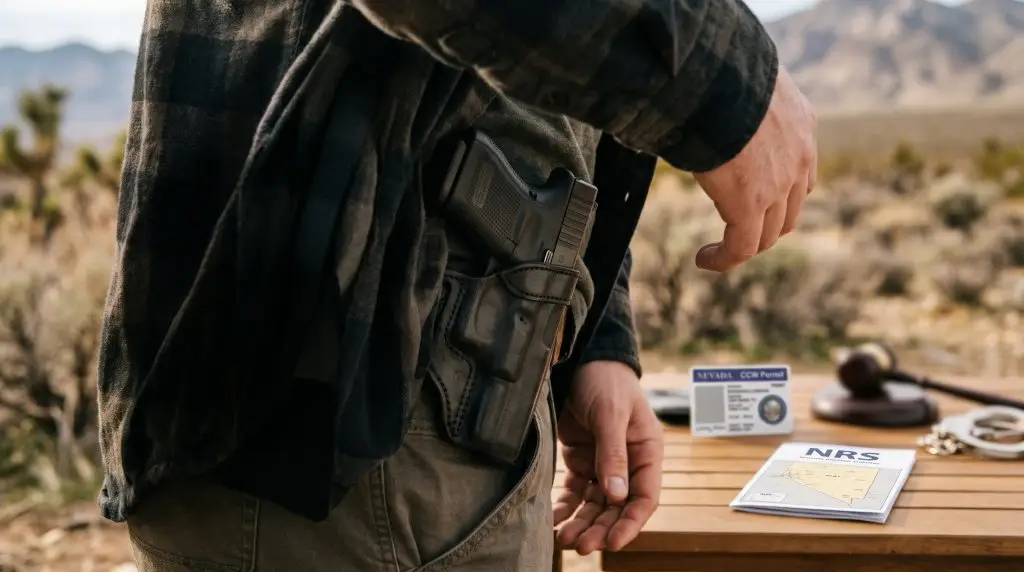
Yes. NRS 202.350 makes it a crime to carry a pistol, revolver, or other firearm concealed on your person unless you hold a valid permit or fall under an exception, such as an on-duty peace officer.
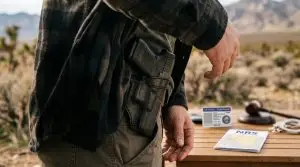
The law defines “concealed” by what other people can see. A weapon is concealed when it is carried “in such a manner as not to be discernible by ordinary observation.” A handgun inside a waistband holster under a shirt, in a jacket pocket, or in a purse you are carrying generally fits that definition.
The penalty is serious. Carrying a concealed firearm without a permit is a category C felony. Under NRS 193.130, a category C felony carries 1 to 5 years in state prison and a fine of up to $10,000. A felony conviction also makes you a prohibited person under NRS 202.360, which means you could lose the right to own any firearm at all.
Nevada permits cover handguns only. The statute defines a “concealed firearm” as a loaded or unloaded handgun, so a permit does not authorize concealing a rifle, a shotgun, or other weapons.
Who Can Get a Nevada Concealed Carry Permit?
The sheriff must issue a permit to anyone who is legally allowed to own a handgun and meets the requirements in NRS 202.3657. To qualify, you must:
- Be at least 21, or at least 18 if you are serving in the Armed Forces, the reserves, or the National Guard, or were honorably discharged
- Not be prohibited from owning a firearm under state or federal law
- Complete an approved firearms safety course that covers handgun use and Nevada’s laws on using a firearm
One permit covers every handgun you own or buy later. You do not have to list each gun on the application.
The sheriff must deny an application, or revoke an existing permit, for certain records and circumstances. These include:
- Any felony conviction
- A misdemeanor involving the use or threatened use of force or violence within the past 3 years
- A conviction for domestic violence or stalking, or a current protective order
- A DUI conviction within the past 5 years, which the law treats as a presumption of habitual alcohol or drug use
- Being on parole or probation, or having an outstanding warrant
- A mental health facility admission within the past 5 years
- A false statement on any permit application
Because a recent DUI can block a permit for 5 years, the outcome of a DUI case can matter well beyond your driver’s license. Our DUI defense work takes that longer-term impact into account.
How Do You Get a CCW Permit in Las Vegas?
Clark County residents apply through the Las Vegas Metropolitan Police Department (LVMPD), which acts as the county sheriff for permits. Nonresidents can apply to any Nevada sheriff, and LVMPD accepts eligible out-of-state applicants. The process works like this:
- Complete an approved course. New applicants take an 8-hour Nevada-certified course with live-fire qualification. LVMPD does not accept out-of-state training certificates, and a certificate is valid for up to one year.
- Gather your documents. Bring a valid state ID showing your current address, your signed course and proficiency certificates, and any required citizenship or military records.
- Apply online or in person. LVMPD accepts online applications and in-person applications at its Records and Fingerprint Bureau.
- Pay the fee and get fingerprinted. Fingerprints and a photo are taken at your appointment for the state and FBI background check.
- Wait for a decision. Under NRS 202.366, the sheriff has up to 120 days after a complete application to approve or deny it. A denial must be in writing with the reasons.
LVMPD’s current fees, effective October 1, 2026, are listed on its concealed firearm permit page:
| Service | LVMPD Fee |
|---|---|
| New permit (includes fingerprinting and FBI background check) | $100 |
| Renewal | $65 |
| Late renewal | $80 |
| Duplicate permit | $15 |
A Nevada permit is valid for 5 years. Renewal requires a shorter 4-hour course and a new background check. You must also notify the sheriff in writing within 30 days if you move or lose your permit.
Where Can't You Carry a Concealed Firearm in Nevada?
A permit does not let you carry everywhere. NRS 202.3673 and related statutes list places where carrying is off limits, along with a few rules that apply wherever you are.
| Location or Situation | What the Law Says | Statute and Penalty |
|---|---|---|
| Public buildings at a public airport | No concealed carry | NRS 202.3673; misdemeanor |
| Public buildings with a metal detector or a no-firearms sign at each public entrance | No concealed carry unless an exception applies, such as written permission from the person in control of the building | NRS 202.3673; misdemeanor |
| Property of a public or private school, a licensed child care facility, or the Nevada System of Higher Education (including UNLV) | No firearms of any kind without written permission from the principal, college president, or facility designee | NRS 202.265; gross misdemeanor |
| Carrying while impaired | No possession of a firearm with a blood or breath alcohol level of 0.08 or more, or while under the influence of a controlled substance (exception for self-defense inside your own home) | NRS 202.257; misdemeanor |
| Casinos, stores, and other private property | The owner can bar firearms; refusing to leave after being told to go can lead to a trespass charge | NRS 207.200; misdemeanor |
Other public buildings, such as many government offices, are generally open to permit holders unless they post signs or screen with metal detectors.
Casinos deserve special attention in Las Vegas. Many resorts have no-weapons policies. Under NRS 207.200, an owner or occupant can give a warning by demanding that a guest leave, and staying after that warning is a misdemeanor. If security asks you to leave or to secure your firearm, comply and leave calmly.
Always carry your permit and a photo ID. NRS 202.3667 requires you to show both if a peace officer asks, and failing to carry them carries a $25 civil penalty for each violation.
Does Nevada Honor Out-of-State Concealed Carry Permits?
Nevada recognizes permits from 28 states, but not all of them. Each year, the Nevada Department of Public Safety reviews which states require training and keep a permit database that Nevada officers can check, then publishes a recognition list.
The list effective July 1, 2026 includes Arizona, Utah, Texas, and Florida, along with 24 other states. Some states qualify only for their enhanced permit, including Idaho, Mississippi, and South Dakota, and North Dakota qualifies for its Class 1 permit only. California, Oregon, and Colorado are not on the list.
This matters in a city with so many out-of-state visitors. A permit that is valid at home does not protect you in Nevada if your state is not on the list. Carrying concealed under that permit is treated the same as carrying with no permit at all.
New residents have a firm deadline. Under NRS 202.3688, once you become a Nevada resident, a recognized out-of-state permit stops covering you if you have not received a Nevada permit within 60 days.
What Happens If You Are Charged With a Concealed Carry Violation?
A concealed carry charge is a criminal case, and the details decide how it turns out. Some charges, like carrying in a posted public building, are misdemeanors. Carrying concealed without a valid permit is a felony that can affect your record, your job, and your right to own firearms in the future.
When you call us, you speak with Ralph Schwartz directly, not a rotating group of associates. With more than 30 years of legal experience, he looks closely at the facts that often decide these cases:
- Whether the firearm was actually concealed or was visible by ordinary observation
- Whether your home-state permit was on Nevada’s recognition list on the date of the stop
- Whether the location was properly posted or fell under a statutory exception
- Whether the stop and search that found the firearm were lawful
It also helps to understand how Nevada classifies offenses. Our guide to the classifications of criminal violations explains the difference between misdemeanors, gross misdemeanors, and felony categories. If a concealed carry question came up after you defended yourself, our post on whether Nevada is a stand your ground state explains when the use of force is justified.
Nevada Concealed Carry Laws: Common Questions
Is Nevada a constitutional carry state?
No. Nevada still requires a permit to carry a concealed firearm. Constitutional carry, sometimes called permitless carry, would let eligible adults carry concealed without a permit, and Nevada law does not allow that today. NRS 202.350 continues to make concealed carry without a permit a felony.
Can you open carry in Nevada?
Nevada’s permit requirement applies to concealed carry, so a person who can legally own a handgun does not need a permit to carry it openly. Open carry is still limited by the same location rules, including school, child care, and university property under NRS 202.265, and by any private owner’s right to ask you to leave.
Can you keep a handgun in your car without a permit?
Nevada’s concealed carry statutes are written around firearms carried “upon” your person. A handgun stored in a glove box or console is not on your person the way one in your waistband is, but a gun in a jacket you are wearing while driving can still be on your person. If you are unsure how the law applies to your situation, get legal advice before you travel.
Do you have to tell police you are carrying?
Nevada law does not include a general duty to announce that you are carrying. However, NRS 202.3667 requires you to show your permit and ID if an officer asks. Staying calm, keeping your hands visible, and following instructions helps keep a routine stop routine.
Talk to a Las Vegas Criminal Defense Attorney About a Weapons Charge
If you were cited or arrested for carrying a firearm in Nevada, call 702-888-5291 to talk with Ralph Schwartz about your case, or
Se habla español.
This article is general information about Nevada law, not legal advice for your specific situation.