
Las Vegas DUI Checkpoints This Memorial Day Weekend
Memorial Day weekend in Las Vegas brings tourist arrivals from California and Arizona, full restaurants and clubs along the Strip, and the largest coordinated DUI enforcement push of the year so far. Las Vegas Metropolitan Police Department, Nevada Highway Patrol, Henderson Police, and other Clark County agencies set up sobriety checkpoints on the major holiday corridors and run saturation patrols through the long weekend.
Knowing how a Las Vegas DUI checkpoint actually works, what officers can legally ask you, and what you do and do not have to do can be the difference between a sixty-second stop and a night at Clark County Detention Center. Ralph A. Schwartz, PC has defended Nevada DUI cases since 1994. This guide is meant to be a calm, plain-language explanation of what every driver should know before the long weekend.
Why Memorial Day Weekend Means Heavy DUI Enforcement in Las Vegas
Memorial Day marks the unofficial start of summer tourist season in Las Vegas. I-15 from the California border, US-95 from Henderson and Boulder City, the Strip, Boulder Highway, and Fremont Street all see traffic surges through the long weekend. The combination of out-of-state drivers unfamiliar with local roads, late-night returns from clubs and shows, and pent-up holiday spending makes the corridor one of the highest-risk DUI windows of the year.
Nevada coordinates its multi-agency DUI enforcement on holiday weekends through the state’s “Joining Forces” program, run by the Nevada Office of Traffic Safety. The program pools NHP, LVMPD, Henderson PD, North Las Vegas PD, Boulder City PD, and other Clark County agencies for combined enforcement on the four biggest holiday weekends: Memorial Day, July 4, Labor Day, and New Year’s. Enforcement combines fixed sobriety checkpoints with saturation patrols throughout the county.
What that means for drivers: more uniformed officers on the road, more checkpoints than usual, and tighter scrutiny at every traffic stop.
Are DUI Checkpoints Legal in Nevada?
Yes. Sobriety checkpoints have been constitutional under federal law since the US Supreme Court’s decision in Michigan Department of State Police v. Sitz, 496 U.S. 444 (1990), which held that the public-safety interest in stopping impaired driving outweighs the minimal intrusion on individual drivers passing through a checkpoint.
Nevada permits sobriety checkpoints under NRS 484C.150. The statute imposes specific procedural requirements:
- Advance public notice of the checkpoint (typically through agency press releases or signs)
- A fixed pattern of stops (every vehicle, every third vehicle, etc.) rather than officer discretion to pick and choose which cars to stop
- Brief contact with each driver unless the officer develops reasonable suspicion of impairment during that contact
An officer at a checkpoint cannot decide to single out particular drivers based on appearance, vehicle type, or who is in the car. If you were stopped because you were singled out rather than because of the announced pattern, that is a defense issue your lawyer can raise.
The procedural requirements matter because they are the same requirements officers and the trial court will reference if your case ends up being challenged. Failure to follow the statute’s procedure can support a motion to suppress.
Where Memorial Day DUI Checkpoints Typically Happen in Clark County
Exact locations are announced 24-48 hours before the holiday weekend through LVMPD and NHP press releases. Common corridors that have hosted Memorial Day weekend checkpoints in prior years include:
- Boulder Highway, the high-volume DUI corridor through East Las Vegas and into Henderson
- Las Vegas Boulevard and the Strip, particularly near hotel and club exits around 1-3 AM
- Charleston Boulevard, the corridor between downtown and Summerlin
- Sahara Avenue and Tropicana Avenue, east-west corridors with bar density
- I-15 northbound between Primm and the Strip, for California drivers returning from a weekend in Nevada
- US-95 and US-93, the Henderson, Boulder City, and Mesquite corridors
Saturation patrols (officers actively looking for impaired-driving cues) cover the entire valley, including Summerlin, Spring Valley, Paradise, and North Las Vegas. If you are heading out this weekend, expect to encounter both fixed checkpoints and roving patrol cars.
What You Have to Do at a Las Vegas DUI Checkpoint
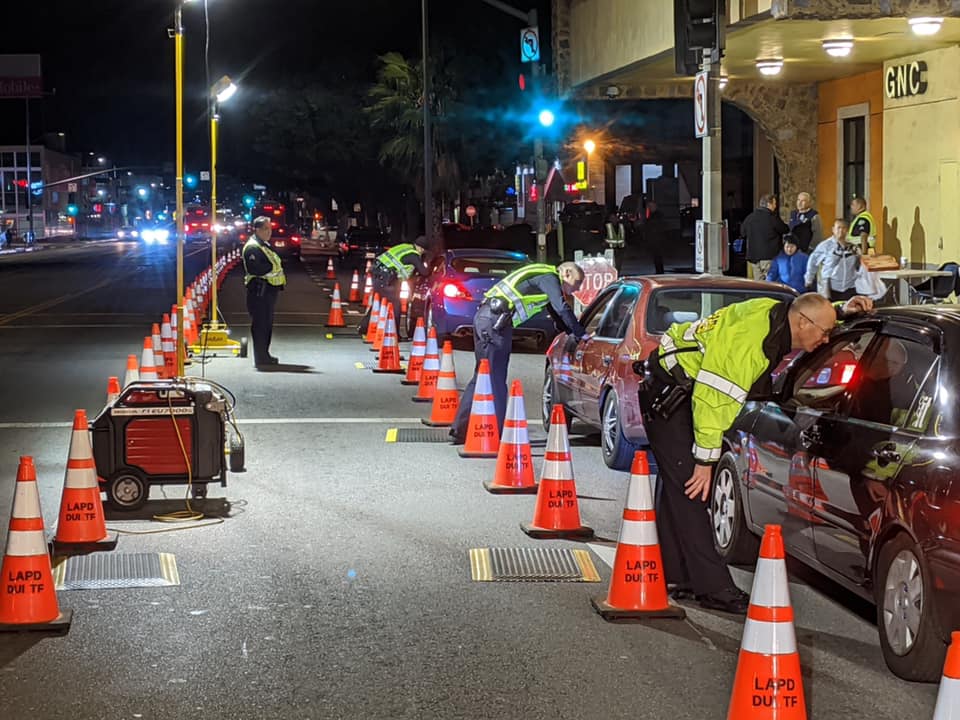
When you approach a marked checkpoint, slow down and prepare to stop. The setup typically uses reflective cones, signage, and uniformed officers with vests. Pull forward calmly when directed.
Be ready to provide:
- Your driver’s license
- Vehicle registration
- Proof of insurance
Roll down your window enough to hand the officer your documents. You are allowed to keep the window from going all the way down, although the officer may ask you to lower it further to assess the inside of the vehicle. If the officer directs you to pull forward, move to a secondary inspection area, or continue through, comply. Refusing to move when directed can become a separate criminal issue.
For most drivers at most checkpoints, this is the entire interaction. Brief contact, document check, move on.
What You Do Not Have to Do at a Las Vegas DUI Checkpoint
This is the section worth bookmarking. Every right below is legal under Nevada and federal law. Politeness matters more than volume. Asserting a right calmly is your protection. Asserting it aggressively gives the officer additional observations that can support an arrest.
You do not have to answer questions about where you came from or where you are going. A polite “I’d rather not answer questions, officer” is your Fifth Amendment right.
You do not have to answer questions about what you have been drinking. Same legal basis. Officers ask this routinely because the answer (or the smell on the answer) develops their case. “I’d rather not answer that, officer” is sufficient.
You do not have to consent to a search of your vehicle. If the officer asks, “Mind if I take a look?”, a polite “Officer, I do not consent to searches” is your Fourth Amendment right. If the officer searches anyway, your lawyer can challenge it later.
Field sobriety tests are voluntary in Nevada at the roadside. The walk-and-turn, the one-leg-stand, and the horizontal gaze nystagmus (the pen test) are designed to develop probable cause for an arrest. They are not designed to clear you. Uneven pavement, medical conditions, footwear, weight, age, and officer training all affect the outcome. Many Nevada DUI defense lawyers, including Ralph A. Schwartz, recommend politely declining roadside field sobriety tests. The officer may still arrest you on other observations, but you are not adding evidence to the case against yourself.
A preliminary breath test (PBT) at the roadside is voluntary for adult drivers. The small handheld device an officer may offer at the roadside is the preliminary breath test, and Nevada law treats it as voluntary for adult drivers. Commercial drivers and drivers under 21 are subject to different rules.
Important: the post-arrest evidentiary chemical test (the breath, blood, or urine test administered after you have been arrested and brought to a station or hospital) is not voluntary. Nevada’s implied-consent law under NRS 484C.160 means that if you are lawfully arrested for DUI, refusing the post-arrest chemical test triggers automatic license revocation, and the officer is authorized to use reasonable force to obtain a blood sample under certain circumstances. The roadside PBT and the post-arrest test are not the same thing. Decline the roadside PBT if you choose, but do not confuse it with the post-arrest test.
If You Are Arrested at a Las Vegas DUI Checkpoint
The clock starts immediately. Two parallel cases begin at the moment of arrest, and most drivers do not realize this until it is too late.
The criminal case begins with booking at Clark County Detention Center, bail and release conditions, and arraignment in Las Vegas Justice Court, Henderson Municipal Court, North Las Vegas Justice Court, or Clark County District Court depending on jurisdiction and severity.
The DMV administrative case is a separate civil proceeding. You have seven days from the arrest to request a DMV administrative hearing under NRS 484C.230, or your license revocation goes into effect automatically. The DMV case is not handled by the criminal court. You can win the criminal case and still lose the DMV case, or vice versa.
In the first 24 hours after a checkpoint arrest:
- Do not give a recorded statement to police beyond identifying yourself.
- Write down the time and location of the stop, the officer’s name and agency, and the badge number if you noted it.
- Save the receipt or paperwork for any chemical test that was administered.
- Note any field sobriety tests that were administered and the conditions (pavement type, lighting, your footwear, any medical conditions you mentioned).
- Call a Las Vegas DUI lawyer for a free consultation.
For the longer post-arrest playbook, read what to do after a DUI arrest (our February 2026 guide).
If you have a prior DUI conviction within the last seven years, the second-offense escalation is significant: mandatory minimum jail, longer license revocation, and mandatory ignition interlock. See second-offense DUI defense for the specifics.
Frequently Asked Questions
Are DUI checkpoints legal in Nevada? Yes, under NRS 484C.150 and the US Supreme Court’s 1990 decision in Michigan v. Sitz. The statute requires advance notice, a fixed stopping pattern, and brief contact unless the officer develops reasonable suspicion of impairment.
Can I turn around to avoid a Las Vegas DUI checkpoint? Legally turning around before the checkpoint zone is not by itself a violation. However, officers can stop you for any actual traffic infraction during the maneuver (illegal U-turn, lane violation, etc.), and driving away from an officer who has already directed you to stop is a separate criminal offense.
Do I have to take a breathalyzer at a Las Vegas checkpoint? The handheld preliminary breath test (PBT) at the roadside is voluntary for most adult drivers. The post-arrest evidentiary chemical test, administered after a lawful DUI arrest, is governed by implied consent under NRS 484C.160 and refusing has automatic license-revocation consequences. The two tests are different.
What if I have a prior DUI on my record? A second offense within seven years escalates to mandatory minimum jail, a one-year license revocation, and mandatory ignition interlock. Talk to a Las Vegas second-offense DUI defense lawyer as soon as you are released.
What if a drunk driver hit me on Memorial Day weekend? The civil claim against the drunk driver is separate from any criminal case the state may bring. Civil compensation can cover medical bills, lost wages, pain and suffering, and other damages. See drunk driver accident claims for how those cases work.
Talk to a Las Vegas DUI Lawyer Today
If you were arrested at a Memorial Day weekend checkpoint, the most time-sensitive piece is the seven-day DMV hearing deadline. The criminal case follows its own timeline. The earlier the defense begins, the more options remain available.
Ralph A. Schwartz, PC handles Las Vegas DUI cases personally. Nevada Bar since 1994, a former insurance defense attorney, and you will receive direct attorney access from intake to outcome.
Schedule Free Consultation or Call 702-888-5291
Free consultation. Fee structure explained at consultation. Se habla español.